

Best Level 2 Chargers for Toyota RAV4 Prime in 2026: Home Ready, 48A Power & Easy Setup
If you drive a Toyota RAV4 Prime, the hardest part of choosing a Level 2 home charger is not finding one—it is knowing which features actually matter for your vehicle. The RAV4 Prime uses an 18.1-kWh battery and a 6.6-kW onboard AC charger, which means a charger advertised at 40A or 48A will not make the SUV charge at 40A or 48A. The vehicle decides how much AC power it can accept, not the biggest number printed on the charger.
For most owners, the meaningful upgrade is a properly installed 240V Level 2 charger. Toyota lists charging from empty in around 2.5 hours under ideal Level 2 conditions, while a standard 120V outlet can take roughly 12 hours. That difference is what makes home Level 2 charging useful in real life—you can plug in after work, let the vehicle charge on your schedule and have the electric range ready without planning your day around a slow outlet.
I looked at these chargers from the perspective of someone who actually has to live with the setup, not just compare specification sheets. J1772 compatibility, cable reach, 240V operation, installation requirements, safety certifications, scheduling and everyday usability matter more than paying extra for charging capacity the RAV4 Prime cannot fully use. The goal here is simple: separate the specifications that genuinely improve your home charging experience from the numbers that simply look impressive on a product page.
Best Level 2 Charger for Toyota RAV4 Prime: Top 2026 Picks for 240V J1772 Home Charging
#1. EMPORIA Level 2 EV Charger 48A 240V WiFi NEMA 14-50
Best Level 2 Charger for Toyota RAV4 Prime for 240V Home Charging, Smart WiFi Energy Monitoring, Flexible NEMA 14-50 Plug-In Setup and Long 25-Foot Cable
#2. EVDANCE Level 2 EV Charger 40A 240V NEMA 14-50
Best RAV4 Prime Level 2 Charger for 40A 240V Home Charging, Adjustable Current Control, NEMA 14-50 Plug-In Installation, Portable Use and 25-Foot Charging Cable
#3. IYILO Level 2 EV Charger 48A 240V 11.5kW
Best RAV4 Prime Home Charger for 240V Level 2 Charging, Adjustable 6A–48A Current, WiFi Scheduling, Energy Monitoring, Connector Temperature Protection and 25-Foot Cable
#4. EVIQO Level 2 EV Charger J1772 48A 240V Hardwired
Best Hardwired Level 2 Charger for Toyota RAV4 Prime With J1772 Compatibility, 48A 240V Capacity, WiFi Scheduling, Energy Tracking, 25-Foot Flexible Cable and Permanent Home Installation
#5. Lectron J1772 Level 2 EV Charger 48A 240V
Best RAV4 Prime J1772 Home Charger for 240V Hardwired Charging, 48A Capacity, 23-Foot Cable, Plug-and-Charge Simplicity, Strong Safety Protection and No-App Operation
Expert Tip: Don’t buy a 48A charger simply because your RAV4 Prime is a plug-in hybrid. The Prime’s 6.6-kW onboard charger is the limit that matters when charging from AC power. A higher-rated Level 2 station can still be a perfectly sensible purchase, but its value is in the installation flexibility, cable length, controls, protection and future use, not in making the RAV4 Prime pull 48 amps. For most owners, I would put more thought into getting the 240V circuit and installation right than paying extra for a bigger amperage number.
How We Choose These RAV4 Prime Level 2 Chargers
I didn’t rank these chargers by the number printed largest on the box. That would make this list look impressive, but it would not help a RAV4 Prime owner make a better purchase.
The first filter was simple: will it work with the RAV4 Prime’s J1772 charging system? From there, I looked at the things that actually change the ownership experience—240V operation, installation type, cable length, connector design, available controls and published safety certifications.
I also treated the 40A and 48A ratings carefully. The RAV4 Prime cannot use those chargers at their full advertised output because its onboard AC charger is rated at 6.6 kW. That means a charger should not earn a higher position merely because it claims more amps. In this roundup, higher amperage is treated as headroom, not as a promise of faster RAV4 Prime charging.
Installation was another major part of the selection. A NEMA 14-50 plug-in charger gives an owner a different kind of flexibility from a hardwired station. Neither is automatically better for every garage. The right choice depends on the electrical setup you already have, where the car is parked and whether you want something that can be unplugged or a more permanent installation.
Cable length matters more than it looks on paper, too. A charger can have excellent specifications and still be frustrating if the cable barely reaches the vehicle’s charge port. That’s why the 23- and 25-foot cable options in this list are meaningful rather than filler specifications.
I also gave extra attention to certification claims. Where a charger lists standards such as UL 2594, ETL or ENERGY STAR, those details are more useful to a buyer than vague phrases such as “fast” or “premium.” At the same time, I have not treated a certification badge as proof that one charger will automatically last longer than another. It is simply one of the concrete things a buyer can verify.
Finally, I looked at what each charger actually adds to a RAV4 Prime owner’s routine. Wi-Fi control can be useful if you want charging information and control from your phone. A long cable can solve an awkward parking position. A hardwired design can suit a dedicated garage installation. A plug-in model can make more sense when flexibility matters. Those differences are why these five products are not simply listed in alphabetical order.
The result is a list built around a simple idea: buy the charger that fits your garage and your RAV4 Prime, not the charger with the most impressive number. That is especially important with newer charging products that may have fewer long-term owner reviews. Where the published specifications are strong, I use them; where a specification does not translate into a real advantage for the RAV4 Prime, I don’t pretend that it does.
#1. EMPORIA Level 2 EV Charger 48A 240V WiFi NEMA 14-50
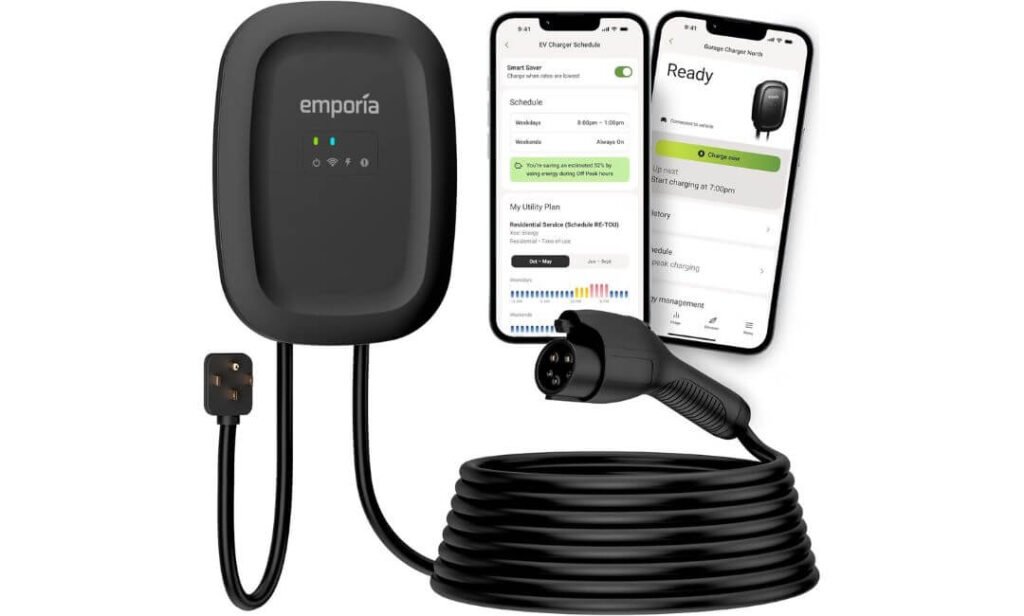
Quick Specs:
- Connector: SAE J1772
- Input: 208/240V AC
- Maximum Output: 48A hardwired / 40A NEMA 14-50
- Cable: 25 ft
- Connection: NEMA 14-50 or hardwired
- Smart Features: 2.4 GHz Wi-Fi, scheduling and energy monitoring
- Enclosure: NEMA 4, indoor/outdoor rated
- Certifications: UL Certified, ENERGY STAR
- Breaker: 50A+ for 40A / 60A+ for 48A
The first thing I like here is that the charger doesn’t force you into one installation style. With a NEMA 14-50 connection, it can deliver up to 40A; if you’re building a permanent setup, the same unit can be hardwired for up to 48A. For a RAV4 Prime, the extra amperage isn’t about making the car charge beyond its own limit. It’s simply nice to have a charger that isn’t the bottleneck if your garage setup changes later. Emporia itself specifies a dedicated 50A+ circuit for the 40A configuration and 60A+ for 48A hardwired operation.
The J1772 connector is exactly the kind of fit you want here, while the 25-foot cable gives you considerably more freedom when the charging port isn’t sitting right beside the wall. The enclosure is also rated NEMA 4 for indoor or outdoor installation, so this isn’t limited to a perfectly sheltered garage wall.
Then there is the part you actually notice after installation: the Wi-Fi app. You can check charging activity, monitor energy use and schedule sessions around cheaper electricity periods. For a plug-in hybrid with a relatively small battery compared with a full EV, that scheduling capability can be genuinely useful—you can plug the vehicle in when you get home and let the system handle when it actually charges.
(The smart features are useful; the 48A number is not the reason your RAV4 Prime will charge faster.)
What We Like About It
- J1772 is the right connector for the RAV4 Prime, so there is no adapter gymnastics involved.
- The NEMA 14-50 and hardwired options give you a choice based on your home’s electrical setup.
- The 25-foot cable is a real garage advantage, especially when the vehicle cannot park nose-first every night.
- Wi-Fi scheduling and energy tracking add something useful beyond simply turning electricity on and off.
- UL certification, ENERGY STAR and a NEMA 4 enclosure give the installation a stronger safety and weather-resistance story.
One Thing to Know Before Buying
The 48A headline can be misleading if you read it as RAV4 Prime charging speed. The vehicle decides how much AC power it accepts, so buying the hardwired version does not suddenly turn the Prime into a 48A-charging vehicle. Think of the higher rating as charger capacity and installation flexibility—not a promise of a shorter charging session.
Why It Earns the Top Spot for RAV4 Prime Level 2 Home Charging
What puts this one at the top isn’t a single flashy specification. It’s the way the pieces fit together: J1772 compatibility, 25-foot reach, plug-in or hardwired installation, smart scheduling and recognized safety certifications. You get useful features without having to buy a charger designed around a capability the Prime cannot fully exploit.
For someone setting up home charging from scratch, that balance matters. You can use the NEMA 14-50 configuration if that suits your garage, or have it hardwired as part of a more permanent installation. Either way, the RAV4 Prime—not the charger—remains in control of the actual charging rate.
The Insider Pro-Tip
If you’re installing this specifically for a RAV4 Prime, don’t let the 48A figure dictate the electrical work. Start with where the car actually parks, how far the cable needs to travel and what your home’s panel can comfortably support. If you choose the NEMA 14-50 route, Emporia specifically calls for an industrial-grade, continuous-duty 50A receptacle rather than an ordinary household outlet, and recommends professional installation. That’s the small detail that separates a proper overnight charging setup from simply putting a powerful charger on the wall.
#2. EVDANCE Level 2 EV Charger 40A 240V NEMA 14-50
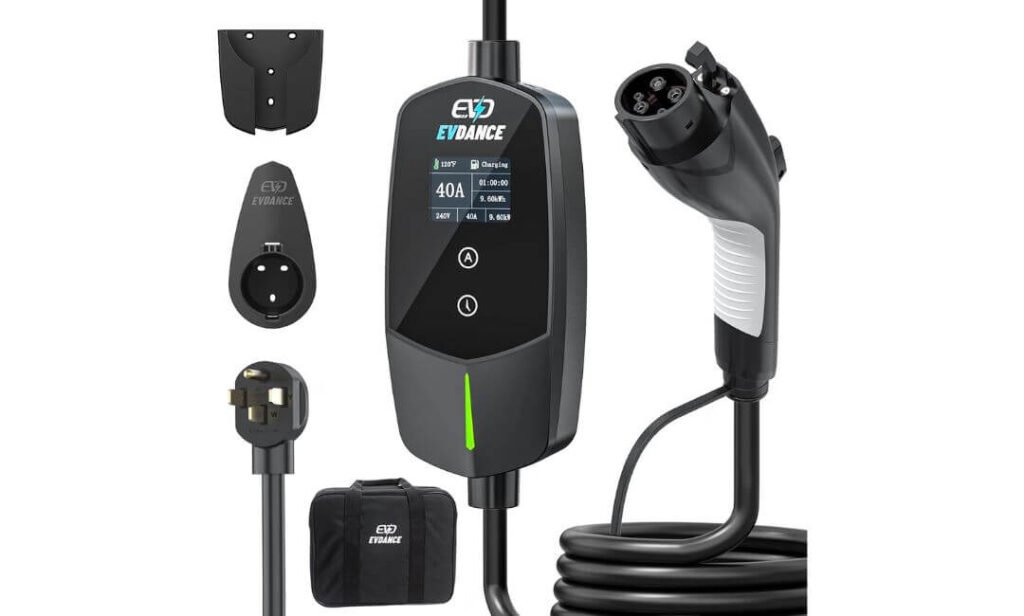
Quick Specs:
- Connector: SAE J1772
- Charging Output: Up to 40A / 9.6kW
- Voltage: 240V
- Plug: NEMA 14-50P
- Cable: 25 ft
- Current Settings: 10A, 16A, 20A, 24A, 32A and 40A
- Display: 2.4-inch TFT screen with charging information
- Scheduling: 1–12 hour delayed start
- Weather Rating: IP66
- Protection: Leakage, grounding, overvoltage, undervoltage, overcurrent, overheating, overcharging and short-circuit protection
- Included: Cable holder, control-box holder and carrying bag
What makes this one interesting is how little you have to complicate the installation. The NEMA 14-50P plug makes it a straightforward plug-in Level 2 setup when the right outlet and circuit are already available, while the 25-foot cable gives you useful freedom when the RAV4 Prime is not parked directly beside the wall. There is also no need to permanently mount the charging equipment just to use it—the included carrying bag and holders make the portable design genuinely practical.
The 10A-to-40A adjustable current is probably the feature I would pay the most attention to. You can select 10A, 16A, 20A, 24A, 32A or 40A rather than being locked into one setting. For a RAV4 Prime, that gives you a sensible way to match the charger to the electrical circuit instead of simply running the highest setting because it is available. The car will still determine how much power it actually accepts.
There is also a surprisingly useful amount of information right on the unit. The 2.4-inch TFT display shows charging current, voltage, power, charging time and operating status, while the 1–12 hour delay function lets you postpone charging without needing an app. That is a nice fit for a plug-in hybrid owner who wants overnight charging at a convenient time but doesn’t particularly care about adding another Wi-Fi device to the home network.
(The appeal here is simple: adjustable charging, a long cable and useful controls without turning the charger into another complicated piece of technology.)
What We Like About It
- Adjustable 10A–40A output gives you genuine control over the electrical load.
- NEMA 14-50P plug keeps the installation straightforward when a suitable circuit is already in place.
- The 25-foot cable is long enough to solve many awkward garage and driveway parking situations.
- Delayed charging up to 12 hours is useful for owners with time-of-use electricity rates.
- The TFT display provides the information you actually want while the vehicle is charging.
One Detail to Keep in Mind
This is deliberately a simple charger rather than a smart-home system. There is no Wi-Fi app or remote cloud control. If you want to start charging from your phone while sitting on the sofa, this isn’t designed around that experience. If you prefer pressing a button, seeing the numbers on the display and letting the car charge, that simplicity can actually be a benefit.
Why It Makes Sense as a RAV4 Prime Level 2 Home Charger
The strength here is practicality. You get J1772 compatibility, 240V Level 2 charging, adjustable current, a 25-foot cable and delayed start without paying for a long list of connected features you may never use. For a RAV4 Prime, that is a sensible combination because the vehicle already controls its own charging rate.
The other advantage is portability. If your charging location changes, the NEMA 14-50 connection and included carrying bag make this considerably easier to move than a permanently hardwired station. Just remember that the outlet and circuit need to be correctly sized for the charging current you select; the charger should never be used as a workaround for an undersized electrical circuit.
The Insider Pro-Tip
Before you plug this into a NEMA 14-50 outlet and immediately select 40A, look at the circuit behind that outlet, not just the outlet face. A 40A charging load is continuous, so the electrical installation has to be sized appropriately for it. If your existing setup isn’t designed for that load, simply selecting 32A or 40A on the screen does not make an unsuitable circuit safe.
For the RAV4 Prime specifically, I would start with the lowest practical setting that comfortably meets your overnight charging needs. You are not giving up meaningful vehicle charging speed by doing that—the vehicle remains the limiting factor anyway. What you gain is a cooler, more sensible home charging setup with the ability to raise the current later if your electrical installation supports it.
#3. IYILO Level 2 EV Charger 48A 240V 11.5kW
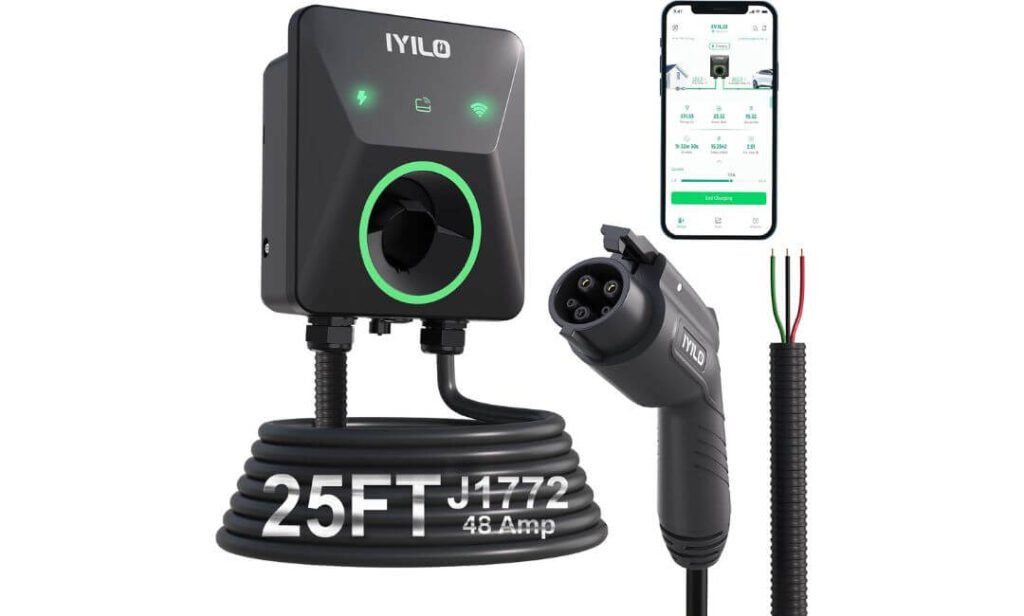
Quick Specs:
- Connector: SAE J1772
- Maximum Output: Up to 48A / 11.5kW hardwired
- Voltage: 240V
- Current Adjustment: 6A–48A in 1A increments
- Installation: Hardwired for 48A operation
- Cable: 25 ft, ultra-flexible
- Smart Control: 2.4 GHz Wi-Fi app, scheduling, energy and cost monitoring
- Safety: Built-in GFCI and connector temperature monitoring
- Weather Rating: NEMA 4
- Certifications: UL 2594, ETL, ENERGY STAR and CSA
- Warranty: 3 years
- Extra Controls: RFID, power sharing and optional dynamic load balancing
Some chargers try to win you over with a big amperage number. This one has a more interesting story. The 6A–48A adjustment in 1A increments gives you unusually fine control over how much load the charger places on the home’s electrical system. For a RAV4 Prime, that matters more than chasing 48A itself because the vehicle will still decide how much AC power it accepts.
The other standout is the connector temperature monitoring. The J1772 connector uses a temperature sensor, and the system can monitor that temperature through the app and stop charging if the connector becomes excessively hot. That is the sort of feature you may never notice when everything is working correctly—and that is exactly what you want from a safety feature. It is there quietly in the background rather than trying to sell you a faster charging number.
Then there is the smart side. The 2.4GHz Wi-Fi app lets you schedule charging, monitor energy consumption and track charging costs, while RFID control gives you another way to start charging without depending entirely on your phone. Add the 25-foot flexible cable and the option for power sharing, and this starts to look less like a basic wall charger and more like a small home charging system.
(The real attraction here is not 11.5kW for the RAV4 Prime; it is the amount of control and protection built around the charging process.)
What We Like About It
- 1A current adjustment from 6A to 48A gives you more control than the usual fixed charging steps.
- J1772 connector temperature monitoring adds a useful layer of protection during long charging sessions.
- Wi-Fi scheduling, energy tracking and cost monitoring make it practical for regular home charging.
- UL 2594, ETL, ENERGY STAR and CSA certifications give buyers concrete safety credentials to check.
- The 25-foot ultra-flexible cable should be much easier to manage around a garage than a short, stiff lead.
One Detail to Keep in Mind
The impressive 48A/11.5kW rating should not be confused with the RAV4 Prime’s actual charging capability. The vehicle remains the limiting point. You are buying the extra capacity for the charger itself, along with its installation flexibility and features—not because the Prime will suddenly accept 11.5kW.
Why It Makes Sense as a RAV4 Prime Level 2 Home Charger
This is the kind of charger that makes sense for someone who wants to build the electrical setup properly and then have more control over it. The combination of adjustable current, smart scheduling, temperature monitoring and J1772 compatibility gives it a stronger everyday-use story than simply saying “48A.”
It also has some genuine future-use value. Power sharing can become useful if another compatible charger is added later, while optional dynamic load balancing can help manage household electrical demand when paired with the manufacturer’s energy meter. For a garage that may eventually serve more than one EV or PHEV, that is a meaningful feature rather than just another app icon.
The Insider Pro-Tip
If you’re choosing this specifically for the RAV4 Prime, I would set the charger around the vehicle and your electrical installation—not around the 48A maximum. Have the electrician confirm the circuit, breaker and available panel capacity first. The charger’s ability to adjust current in single-amp increments means you have plenty of room to choose a sensible setting instead of treating 48A as the default.
And pay attention to the 2.4GHz Wi-Fi requirement before installation. If your garage has weak 2.4GHz coverage, the charger will still be able to charge without relying on the app, but you won’t get the full benefit of remote scheduling and monitoring. In other words, the hardware is doing the important work; Wi-Fi should be considered a convenience layer, not something your RAV4 Prime depends on to charge.
#4. EVIQO Level 2 EV Charger J1772 48A 240V Hardwired
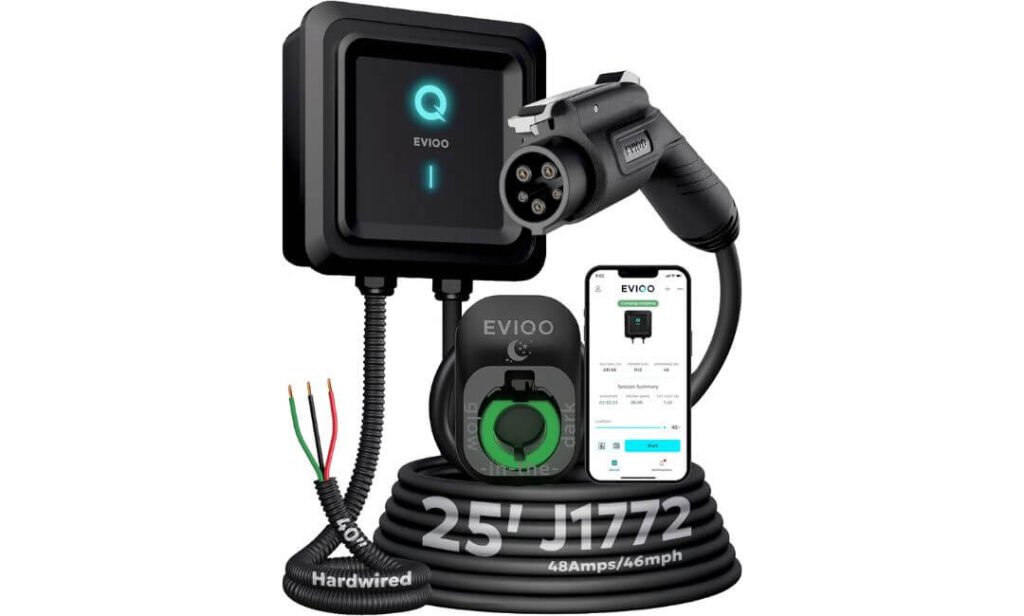
Quick Specs:
- Connector: SAE J1772
- Maximum Output: Up to 48A / 11.5kW
- Voltage: 240V
- Installation: Hardwired
- Recommended Circuit: Dedicated 60A circuit for 48A operation
- Current Adjustment: 6A–48A
- Cable: 25 ft, flexible
- Smart Features: 2.4 GHz Wi-Fi, charging schedules, energy and cost tracking
- Protection: Overcurrent, overvoltage, overtemperature and ground-fault protection
- Weather Rating: IP66 / NEMA 4
- Certifications: UL, ETL, ENERGY STAR and FCC
- Warranty: 3 years
- Extra Features: Glow-in-the-dark holster, instant reset button and OTA updates
A hardwired charger makes the most sense when you are treating home charging as a permanent part of the garage, and that is where this one has a clear identity. There is no NEMA 14-50 plug to manage—the unit connects directly to a dedicated 240V circuit and can be configured for up to 48A, with charging current adjustable from 6A to 48A. For the RAV4 Prime, that maximum is more capacity than the vehicle needs, but the adjustable range gives your electrician room to configure the installation sensibly.
The 25-foot cable is another detail that becomes surprisingly important once the charger is actually on the wall. You are not forced to park with the charge port directly beside the unit, and the flexible construction should make everyday cable handling less awkward. The glow-in-the-dark holster sounds like a small gimmick until you are plugging in after dark; then being able to immediately see where the connector belongs is genuinely convenient.
What I particularly like is the combination of smart and simple operation. The 2.4GHz Wi-Fi app can handle scheduling, energy tracking and charging-current adjustments, but basic charging does not depend on the app. If the network is unavailable, you can still plug in and let the vehicle charge. The one-button reset is another practical touch—you can restart the charger without opening the enclosure or walking to the electrical panel.
(This is a charger built more around everyday ownership than a long list of flashy specifications.)
What We Like About It
- Native J1772 connection makes it a straightforward match for the RAV4 Prime.
- Hardwired 240V installation is well suited to a permanent home charging location.
- The 25-foot flexible cable gives you useful freedom in a larger garage or driveway.
- Wi-Fi scheduling and energy tracking add genuine value if you use time-of-use electricity rates.
- The glow-in-the-dark holster and reset button are small but unusually practical touches for daily use.
One Detail to Keep in Mind
This is hardwired only, so it is not the charger to choose if you want something you can simply plug into an existing NEMA 14-50 outlet. You will need an appropriately sized dedicated circuit and a professional installation. For a permanent setup that is not necessarily a drawback—it simply means the electrical work should be planned before the charger goes on the wall.
Why It Earns a Place Among the Best RAV4 Prime Level 2 Home Chargers
The appeal here is the complete installation rather than one headline number. You get J1772 compatibility, adjustable 6A–48A charging, a 25-foot cable, smart scheduling, weather-resistant construction and straightforward reset controls in one permanent unit. The RAV4 Prime does not need 48A, but having a charger with that capacity gives the installation some room beyond the vehicle’s present requirements.
It is also a good example of why I would not rank chargers purely by maximum amperage. For this vehicle, the useful differences are what happens around the charging process: where you can mount it, how easily the cable reaches the car, whether you can schedule charging and how simple it is to recover from a minor fault. EVIQO covers those everyday details particularly well.
The Insider Pro-Tip
If you are installing this for a RAV4 Prime, tell the electrician about the vehicle before deciding how to configure the circuit. There is little reason to build the entire installation around the charger’s 48A maximum simply because it is available. What matters is having a correctly sized circuit, proper protection and a charging current that makes sense for the car and your home’s electrical capacity.
One more thing is worth remembering: the Wi-Fi connection is a convenience, not the charging system itself. Set your schedules if they save you money, enjoy the energy tracking, but don’t hesitate to use straightforward plug-and-charge operation when you just want to come home, connect the J1772 plug and let the RAV4 Prime take care of the rest.
#5. Lectron J1772 Level 2 EV Charger 48A 240V Hardwired
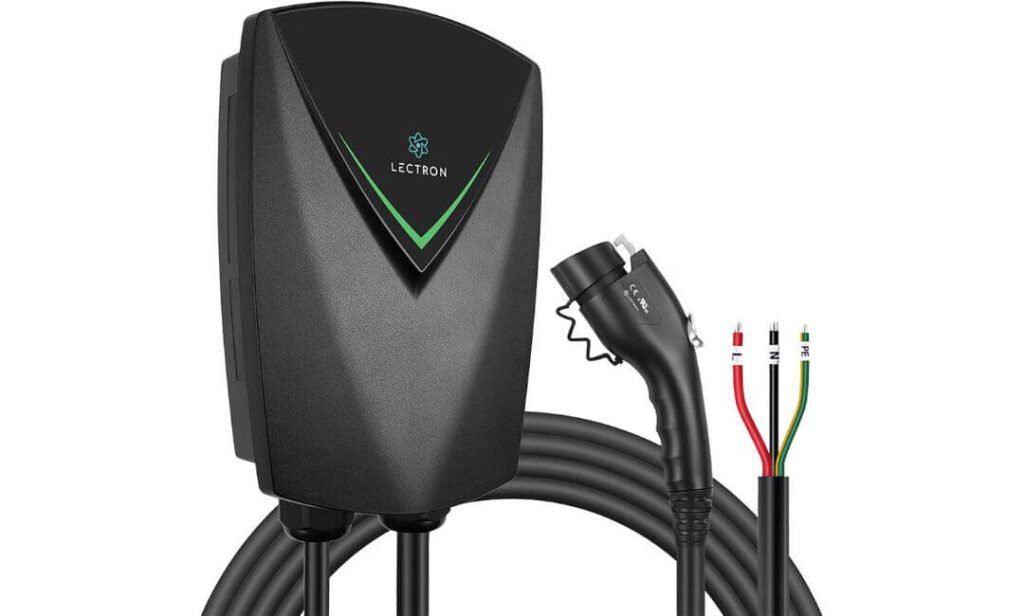
Quick Specs:
- Connector: SAE J1772
- Maximum Output: 48A / 11.5kW
- Voltage: 240V
- Installation: Hardwired only
- Circuit: Dedicated 60A circuit for 48A operation
- Current Control: Fixed 48A
- Cable: 23 ft
- Smart Features: None — plug-and-charge operation
- Weather Rating: IP66
- Certifications: UL 2594, UL 2231, UL 2251, ETL, ENERGY STAR and FCC
- Included: J1772 holster
- Warranty: 3 years
There is something refreshing about a charger that doesn’t try to turn every charging session into a smartphone experience. This unit is hardwired, fixed at 48A and designed to do one job: provide a dependable J1772 connection whenever you plug in. There is no Wi-Fi account to create, no app to configure and no charging schedule buried inside another menu. For a RAV4 Prime that already has its own charging controls, that simplicity can make perfect sense.
The 23-foot cable is long enough for most garage layouts, and the included holster gives the J1772 connector a proper place to live instead of leaving it hanging or sitting on the floor. The IP66 enclosure also means the unit isn’t restricted to a perfectly protected indoor wall. If the charger has to live in a garage that gets dusty or on a suitably protected exterior wall, its weather-resistant construction gives you more flexibility.
Then there is the safety side. UL 2594, UL 2231 and UL 2251 certification, along with ETL and ENERGY STAR listings, give this charger a substantial certification package. Internally, it provides protection against conditions such as overcurrent, voltage faults, overheating and ground faults. Those are the details I would rather see in a permanent charger than another collection of features I may never use.
(Sometimes the smartest charging setup is the one you plug in and stop thinking about.)
What We Like About It
- Fixed 48A J1772 charging keeps the operation straightforward.
- No Wi-Fi or app dependency means fewer things that can interfere with basic charging.
- The 23-foot cable and dedicated holster make everyday garage use easier.
- IP66 weather protection gives it useful indoor or outdoor installation flexibility.
- The combination of UL, ETL and ENERGY STAR credentials gives the hardware a strong safety and efficiency foundation.
One Detail to Keep in Mind
The fixed 48A output is the main thing to check before ordering. Unlike the adjustable chargers above it, this one does not let you dial the current down through software or switches. That means your electrician needs to confirm that your electrical panel and dedicated circuit are appropriate for a 48A continuous charging load before installation.
Why It Still Deserves a Place Among the Best RAV4 Prime Level 2 Home Chargers
For this vehicle, the biggest attraction isn’t that it can deliver 48A. The RAV4 Prime controls its own AC charging rate anyway. The attraction is the clean, dedicated installation and uncomplicated ownership experience. Once the electrician has installed the correct circuit, there is very little between you and the simple routine of plugging in the J1772 connector.
It also makes sense for owners who don’t want another connected appliance competing for attention on their home network. You lose app-based scheduling and energy reports, but you also lose the possibility of Wi-Fi becoming part of the troubleshooting process. If your priority is permanent home charging with as little fuss as possible, that trade-off is worth understanding.
The Insider Pro-Tip
Before buying this one, have an electrician look at your panel capacity and the proposed 60A circuit, rather than assuming that because you have space for another breaker, the panel is automatically ready for it. The charger is fixed at 48A, so there is no lower-current setting to fall back on if the planned circuit cannot support the full continuous load.
And don’t dismiss the lack of an app as a missing feature. With a RAV4 Prime, simple can actually be the better experience. If you want scheduled charging, use the vehicle’s own charging controls; if you simply want to come home, connect J1772 and know that the charger is doing its job without asking you to open your phone, this approach has a very clear advantage.
Best Level 2 Charger for Toyota RAV4 Prime: Detailed Comparison of 40A and 48A Chargers for Home Charging
| Charger | RAV4 Prime Fit | Power & Connection | Installation | Everyday Features | Cable | Safety & Build | Best For |
|---|---|---|---|---|---|---|---|
| EMPORIA Level 2 EV Charger Best Overall |
J1772 A natural match for the RAV4 Prime’s AC charging system. |
48A hardwired Up to 40A with NEMA 14-50 |
Plug-in or hardwired Flexible for different garage setups |
2.4GHz Wi-Fi Scheduling, energy monitoring and cost tracking |
25 ft Useful reach for larger garages |
UL Certified ENERGY STAR · NEMA 4 |
Balanced home charging Smart controls without overcomplicating the setup |
| EVDANCE Level 2 EV Charger Best Plug-In Option |
J1772 Designed for J1772 EVs and PHEVs. |
40A / 9.6kW 240V · NEMA 14-50P |
Plug-in No hardwiring when a suitable NEMA 14-50 circuit is already available |
Adjustable 10A–40A 1–12 hour delayed start · TFT display |
25 ft Includes cable holder and carrying bag |
IP66 Multiple electrical and temperature protections |
Flexible charging Best when portability and manual current control matter |
| IYILO Level 2 EV Charger Best Smart Safety Features |
J1772 Compatible with J1772-equipped North American EVs and PHEVs. |
48A / 11.5kW 240V · adjustable 6A–48A |
Hardwired for 48A Designed around a dedicated circuit |
2.4GHz Wi-Fi Scheduling · energy/cost tracking · RFID · power sharing |
25 ft Ultra-flexible cable design |
UL 2594 · ETL · ENERGY STAR CSA · built-in GFCI · connector temperature monitoring |
Safety-focused smart charging Particularly interesting for owners who value monitoring and control |
| EVIQO Level 2 EV Charger Best Hardwired Setup |
J1772 Native connector for the RAV4 Prime. |
48A / 11.5kW 240V · adjustable 6A–48A |
Hardwired only Dedicated 60A circuit for 48A operation |
2.4GHz Wi-Fi Scheduling · energy tracking · OTA updates · reset button |
25 ft Flexible, cold-resistant cable |
UL · ETL · ENERGY STAR IP66 / NEMA 4 · internal steel shielding |
Permanent garage installation A strong fit when you want a dedicated wall-mounted setup |
| Lectron Nexus Level 2 EV Charger Best No-App Option |
J1772 Direct J1772 connection for the RAV4 Prime. |
48A / 11.5kW 240V · fixed 48A output |
Hardwired only Dedicated 60A circuit required for 48A operation |
Plug-and-charge No Wi-Fi, app or account required |
23 ft Includes dedicated J1772 holster |
UL 2594 · UL 2231 · UL 2251 ETL · ENERGY STAR · IP66 |
Simple permanent charging Ideal for owners who prefer fewer connected features |
| RAV4 Prime reality: A 40A or 48A charger does not mean the vehicle will draw 40A or 48A. The onboard charger in the RAV4 Prime determines the actual AC charging rate. Higher-rated stations mainly provide installation flexibility, controls and future capacity. | |||||||
RAV4 Prime Charging Basics You Should Know
Before choosing a home charger, it helps to separate what the charger can deliver from what the RAV4 Prime can actually accept. That one distinction clears up most of the confusion around 40A, 48A, 240V, charging times and the different installation options.
The RAV4 Prime is a plug-in hybrid, not a full battery-electric vehicle, so its battery is much smaller than what you find in most modern EVs. The earlier RAV4 Prime uses an 18.1-kWh battery, while Toyota’s newer RAV4 Plug-in Hybrid continues with a 6.6-kW onboard AC charging system. In practical terms, you don’t need an enormous charger to make good use of the vehicle’s battery; you need a properly installed Level 2 supply that can comfortably meet the car’s charging requirements.
What a Level 2 Charger Does for the RAV4 Prime
A Level 2 charger uses 240V AC power instead of the 120V supply used by a conventional household outlet. That higher-voltage connection is what makes home charging substantially quicker and more useful when you drive the vehicle regularly.
For the RAV4 Prime, the biggest advantage is not achieving an extreme charging rate. It is being able to replenish the relatively small plug-in battery within a normal part of the day. If you arrive home with the battery low, a properly installed Level 2 setup can have the vehicle ready again much sooner than leaving it connected to a standard household outlet overnight.
Toyota has stated that the RAV4 Prime can charge in around 2.5 hours under ideal Level 2 conditions, while charging from a conventional 120V outlet takes considerably longer. Actual times vary with battery temperature, starting state of charge, electrical conditions and the vehicle’s charging controls, so treat the advertised figure as an ideal reference rather than a promise for every driveway or garage.
There is another practical benefit that gets overlooked: you can drive electrically more often when charging is convenient. A Level 2 charger is particularly useful for owners who make several trips during the day and want to recover the battery between them, rather than relying solely on an overnight Level 1 session.
RAV4 Prime 240V Charger Basics: Plug-In vs Hardwired
A 240V home charger generally comes down to two installation approaches: plug-in or hardwired. Both can provide Level 2 charging, but they suit different homes.
A NEMA 14-50 plug-in charger connects to a properly installed 240V receptacle. The advantage is flexibility. If the charger needs to be removed later, or you move to another home, the charging station itself can be unplugged. It can also be convenient when a suitable outlet already exists in the garage.
However, don’t interpret “plug-in” as “plug it into any 240V outlet.” EV charging is a continuous electrical load, so the receptacle, breaker, wiring and installation all need to be correctly sized for the current you intend to use. A 50A receptacle does not automatically mean every charger connected to it should be configured for 50A charging.
A hardwired charger is connected directly to the home’s electrical system by an appropriate circuit. There is no large plug or receptacle between the charger and the panel, which can make for a cleaner permanent installation. It can also allow certain chargers to operate at their higher advertised output when the electrical system is designed for it.
For the RAV4 Prime, though, hardwired does not automatically mean faster charging. If the vehicle is the limiting factor, switching from a plug-in 40A-capable charger to a hardwired 48A station will not make the RAV4 Prime suddenly accept 48A.
The better question is therefore: Which installation makes sense for your garage, electrical panel and long-term plans?
Common Connectors: J1772 Compatibility and Why It Matters
For the RAV4 Prime, the connector is one of the easiest things to get right. The vehicle’s AC charging connection uses the SAE J1772 standard, so the chargers in this roundup use a J1772 connector designed to plug directly into the vehicle.
That matters because you don’t want to buy a charger based purely on its amperage and then discover that its connector isn’t the correct one for your vehicle. A native J1772 Level 2 connection keeps the setup straightforward: connect the charger, let the vehicle communicate with it and allow the RAV4 Prime to determine the charging rate it can accept.
J1772 is also widely used across North American EVs and plug-in hybrids, which gives a J1772 home charger some usefulness beyond one vehicle. If you eventually replace the RAV4 Prime with another J1772-equipped EV or PHEV, the charger may continue to serve you.
One detail worth keeping straight is that J1772 describes the AC charging connection. It should not be confused with DC fast-charging connectors such as CCS. A home Level 2 charger is supplying AC power; the vehicle’s onboard charger handles that electricity before it reaches the battery.
What 40A, 48A and 50A Really Mean for the RAV4 Prime
This is where charger marketing can become confusing.
A charger advertised as 40A means the charging equipment is capable of supplying up to 40 amps under the appropriate electrical conditions. A 48A charger has a higher maximum capability, while a 50A configuration can provide still more capacity when the equipment and circuit are specifically designed for it.
That does not mean a RAV4 Prime will automatically charge at whichever number is printed on the charger.
Think of the system as a conversation between the electrical circuit, the charger and the vehicle:
- The home electrical circuit determines how much power can safely be supplied.
- The charger manages and communicates the available charging current.
- The RAV4 Prime’s onboard charger determines how much AC power the vehicle can actually accept.
The smallest limitation in that chain effectively determines the charging rate.
This is why I would not choose a charger simply because it says 48A instead of 40A. For the RAV4 Prime, the extra rating is mainly useful for charger headroom, installation flexibility and potential future vehicle use. It is not a shortcut to charging the Prime faster than its onboard system allows.
The same thinking applies to a charger advertised as 50A. If the vehicle cannot accept that much AC power, the additional capacity remains unused during that particular charging session. It may still be useful if you intend to use the charger with another EV later, but it shouldn’t be presented as a RAV4 Prime charging-speed advantage.
How Much Charger Do You Actually Need?
For most RAV4 Prime owners, the sensible target is not the biggest charger you can install. It is a reliable 240V Level 2 station with the right J1772 connector and an electrical installation that is comfortable with its configured current.
A 40A-capable charger can already provide considerably more charging capacity than the RAV4 Prime needs to make Level 2 home charging worthwhile. A 48A model can still be a good purchase if you want additional headroom, smarter controls, hardwired installation or future compatibility with another EV.
I would look at these factors in roughly this order:
- Correct J1772 connector
- Proper 240V electrical installation
- Charging current appropriate for the circuit
- Cable length that reaches the vehicle comfortably
- Plug-in or hardwired design that suits your garage
- Useful scheduling or energy-management features
- Safety certifications and protective features
- Future flexibility if another EV may eventually use the charger
That approach keeps the decision grounded in how a RAV4 Prime is actually used. The charger should fit the vehicle and the home—not the other way around.
RAV4 Prime Level 2 Charger Buying Guide for a Smarter Home Setup
There is no single charger specification that makes one unit automatically right for every RAV4 Prime owner. The better approach is to start with the vehicle, electrical system and garage layout, then decide which features are actually worth paying for.
A good charger should make charging feel boring in the best possible way: plug in, walk away and know the vehicle will be ready when you need it. The sections below focus on the details that can make that experience easier—or create unnecessary headaches if they are overlooked.
Amperage: Do Not Buy the Biggest Number Just Because It Is There
Amperage is probably the most misunderstood specification on a Level 2 charger.
The five chargers in this roundup range from 40A to 48A, but that does not mean the higher-rated models will charge a RAV4 Prime proportionally faster. The vehicle’s onboard AC charging system ultimately controls how much power it accepts.
That makes the decision more practical:
| Charger rating | What it means for your RAV4 Prime |
|---|---|
| 40A | Plenty of charger capacity for a dedicated home Level 2 setup |
| 48A | Extra charger headroom, useful for future EVs and some installation choices |
| 50A-capable | More capacity again, but not an automatic RAV4 Prime charging-speed advantage |
A higher-rated charger can still be worthwhile. For example, you may prefer a 48A unit because it offers hardwired installation, better smart controls, power management or future flexibility. Just don’t pay more solely because you expect the Prime itself to charge at 48A.
J1772 Is the Connector You Want for AC Home Charging
For a North American RAV4 Prime, SAE J1772 is the key connector specification to look for when buying a Level 2 home charger.
That gives you a direct connection without needing an adapter for the vehicle’s normal AC charging setup. It also gives the charger broader usefulness because J1772 remains common across many EVs and plug-in hybrids.
I would check the connector before looking at Wi-Fi, amperage or advertised charging speed. A charger with impressive specifications is of little use if the connection isn’t appropriate for your vehicle.
Also keep the terminology straight: J1772 is an AC charging connector, while DC fast charging uses a different vehicle-side arrangement. A home Level 2 charger is not a substitute for a public DC fast charger.
Cable Length Can Matter More Than Another 8A of Charger Capacity
This is one of those specifications that looks minor until you actually live with the charger.
A 23- or 25-foot cable can make the difference between comfortably reaching the charge port and having to reposition the vehicle every time you plug in. It is especially useful in a two-car garage, a driveway installation or a situation where the electrical panel isn’t close to the normal parking position.
Before installation, picture where the RAV4 Prime will actually sit.
Ask yourself:
- Where will the charging station be mounted?
- Where is the vehicle’s charge port when parked normally?
- Does the cable need to pass around another vehicle?
- Will the cable reach without being stretched?
- Where will you store the connector when charging is finished?
- Is there enough room to keep the cable off the floor?
A longer cable is useful, but don’t automatically assume longer is always better. Extra cable also means more weight to manage. The sweet spot is enough reach without creating a pile of unused cable around the garage.
Enclosure and Weather Protection Matter if the Charger Lives Outside
If the charger is going into a protected garage, enclosure rating may not be your biggest concern. For an outdoor installation, it becomes much more important.
Look for a clearly stated weather-resistance rating rather than vague wording such as “all weather” or “outdoor ready.”
Several options in this roundup use ratings such as IP66 or NEMA 4, which indicate that the enclosure is designed to provide substantial protection against dust and water exposure. That does not mean you should install the charger wherever you want without considering the environment.
Think about:
- Direct rain and snow exposure
- Standing water or drainage
- Sun exposure
- Extreme temperature swings
- Cable placement
- Physical impact
- Distance from the electrical panel
- Whether the manufacturer actually permits outdoor installation
For an outdoor RAV4 Prime charging location, I would rather have a properly rated enclosure and sensible mounting position than rely on a charger being marketed as “weatherproof.”
Smart Features: Useful When They Solve a Real Problem
Wi-Fi is useful, but it should not be treated as a requirement for good home charging.
A smart charger can let you schedule charging, monitor energy consumption, track costs and control sessions from a phone. That becomes particularly useful if your electricity provider uses time-of-use pricing.
But there is an important distinction between a useful smart feature and a feature that simply looks impressive in a product listing.
For a RAV4 Prime, I would prioritize:
- Charging schedules for cheaper electricity periods
- Energy-use monitoring
- Charging-cost information
- Adjustable current
- Reliable basic plug-and-charge operation
- Firmware updates where supported
The ability to charge normally when Wi-Fi is unavailable is particularly valuable. A charger should not become useless just because your router is offline.
That is why the simpler non-connected approach can also make sense. If you don’t care about remote monitoring or electricity-cost tracking, there is nothing wrong with choosing a charger that simply connects to the vehicle and charges.
Safety Features Are More Important Than Extra Charging Modes
A Level 2 charger is handling a substantial continuous electrical load, so safety specifications deserve more attention than decorative features.
Look for recognized certifications and clearly documented protection against conditions such as:
- Overcurrent
- Overvoltage
- Undervoltage
- Ground faults
- Overheating
- Short circuits
- Connector temperature problems, where supported
Certifications such as UL 2594, ETL and ENERGY STAR can provide useful evidence that the product has gone through relevant testing or certification processes. They are not a guarantee that a particular unit will never fail, but they are far more meaningful than a seller simply calling a charger “premium.”
The installation itself matters just as much. Even a well-certified charger cannot compensate for an incorrectly sized circuit, unsuitable receptacle, poor connections or an overloaded electrical panel.
RAV4 Prime Level 2 Charger Installation Considerations
The charger is only one part of the installation.
Before ordering, look at the electrical panel, cable route and final mounting location. A short distance between the panel and charger can make installation relatively straightforward. A long run through a finished garage, exterior wall or detached structure can change the cost considerably.
For a plug-in setup, the receptacle needs to be appropriate for continuous EV charging and installed on a properly sized circuit. Do not assume an existing NEMA 14-50 outlet is automatically suitable simply because the plug fits.
For a hardwired installation, the electrician will need to determine the appropriate breaker, conductor size, circuit configuration and available panel capacity based on the charger’s configured current and local electrical requirements.
Clearance also matters. Leave enough space around the charger for ventilation, cable handling, connector storage and servicing. Don’t hide the unit behind shelving or mount it where the cable has to make an awkward, sharp bend every evening.
And if the charger is going outside, plan the entire route—not just the final few feet to the vehicle.
Plug-In vs Hardwired: Which Setup Makes More Sense?
Neither installation type automatically wins. The right choice depends on what you want from the home charging setup.
| Consideration | Plug-In Level 2 | Hardwired Level 2 |
|---|---|---|
| Installation | Requires a suitable high-current receptacle | Direct electrical connection |
| Flexibility | Easier to unplug or move | Designed as a permanent installation |
| Best use | Existing suitable outlet or flexible setup | Dedicated long-term charging location |
| Higher-output operation | Depends on charger and circuit | Often supports the charger’s higher configuration |
| Maintenance | Receptacle becomes another component to inspect | Fewer plug/receptacle connections |
| Installation work | Still requires correct electrical work | Professional installation is normally appropriate |
| RAV4 Prime benefit | Convenient and flexible | Clean, permanent garage setup |
For a renter or someone who may move, the plug-in route can be attractive. You aren’t permanently tying the charging station to the home’s electrical infrastructure.
For a homeowner who knows exactly where the RAV4 Prime will be charged every night, hardwiring can create a cleaner permanent installation.
The important point is that hardwiring should not be sold as automatically faster for the RAV4 Prime. The vehicle still determines the actual AC charging rate.
Compatibility Checks Before You Buy
Before clicking the purchase button, verify these five things:
- Connector: Confirm the charger uses the appropriate J1772 connection for your RAV4 Prime’s AC charging port.
- Electrical supply: Know what your home’s panel and proposed circuit can support.
- Installation type: Decide whether you want NEMA 14-50 plug-in or hardwired installation.
- Cable reach: Measure the actual distance from the proposed wall location to the vehicle’s charge port.
- Outdoor suitability: If mounting outside, verify that the manufacturer permits outdoor use and check the enclosure rating.
Also be careful with model-year information. Toyota’s naming and plug-in-hybrid lineup can change across model years and markets. Check the exact vehicle and market you own before relying on a generic compatibility statement from a seller.
Warranty and Support Are Part of the Purchase
A home charger is something you may use several times a week for years, so warranty coverage deserves a place in the buying decision.
The products here offer different combinations of manufacturer warranty, customer support and software support. A longer warranty does not automatically mean a product is better, but it gives you another layer of protection if the hardware develops a fault.
I would look for:
- A clearly stated warranty period
- A recognizable manufacturer
- Accessible technical support
- Clear replacement or repair procedures
- Firmware support for smart chargers
- Documentation that is easy to find before installation
This matters particularly with smart charging equipment. A charger can be excellent hardware, but if the app becomes unreliable or support disappears, some of its advertised convenience can disappear with it.
Future-Proofing Without Overbuying
Future-proofing is useful, but it is easy to take it too far.
If the RAV4 Prime is your only vehicle and you plan to keep it for years, a properly installed Level 2 charger that comfortably meets its requirements may be all you need.
If you think you may add a full EV later, a higher-capacity charger can make more sense. Features such as adjustable current, load management, power sharing and higher maximum output may become useful with a vehicle that can actually accept more AC power.
That is where the 48A models in this roundup have an argument beyond the RAV4 Prime itself. Their additional capacity is future flexibility, not a promise that today’s RAV4 Prime will charge at the charger’s maximum rating.
The best future-proof purchase is therefore not necessarily the most powerful one. It is the charger whose installation, electrical capacity, controls and connector fit make sense for both your current vehicle and the next one you might realistically own.
RAV4 Prime Level 2 Charger Installation and Setup Guide
Installing a Level 2 charger for a RAV4 Prime is not simply a matter of mounting a box on the wall and plugging it into the vehicle. The electrical circuit, breaker size, receptacle or hardwired connection, charger settings, cable routing and final testing all need to work together.
The good news is that the actual charging routine is simple once the installation is done correctly. The important part is getting the electrical side right before the first charging session. For a permanently installed Level 2 charger, I strongly recommend using a qualified electrician familiar with electric-vehicle charging installations rather than treating the job like a normal garage outlet installation.
Start With a Pre-Installation Electrical Assessment
Before buying the charger or drilling mounting holes, check the home’s electrical system.
The first question is not “Can I install a 48A charger?” It is “What can my electrical panel safely support?”
An electrician should look at:
- Available capacity in the main electrical panel
- Existing large electrical loads
- Available breaker spaces
- Existing service rating
- Distance between the panel and charger location
- Required conductor size and wiring method
- Whether the installation is indoors or outdoors
- Local electrical-code requirements
- Whether a permit or inspection is required in your area
- The charger’s maximum configurable current
- Whether the charger requires a neutral conductor or only the conductors specified by its installation instructions
Do not assume that an empty breaker position means the panel has enough capacity. A panel can have physical breaker space while still having limited available electrical capacity.
Understand the Difference Between 40A and 50A Circuits
This is especially important because several chargers marketed for the RAV4 Prime are rated around 40A or 48A.
A 40A continuous charging load generally requires a circuit rated above 40A, while a charger configured for 48A typically requires a substantially larger circuit. The exact breaker, conductor and installation requirements must follow the charger’s instructions and applicable electrical code.
For example, a charger configured for 48A commonly uses a 60A circuit, but that does not mean every 48A charger can simply be connected to any 60A circuit. The complete installation still needs to be correctly designed.
There is another important distinction with plug-in chargers. If you are installing a NEMA 14-50 receptacle, the receptacle, wiring, breaker and charger configuration must all be compatible. A 14-50 outlet is not a magic “50A EV charger outlet.”
And remember the RAV4 Prime’s limitation: the vehicle does not suddenly consume 40A or 48A just because the charger can provide it. The charger’s rating is its capability; the vehicle’s onboard charging system determines its actual AC intake.
Decide Where the Charger Should Be Mounted
The best charger location is usually the one that allows the cable to reach the RAV4 Prime naturally without stretching across a walking path.
Before mounting anything, park the vehicle exactly where you normally leave it and physically estimate the cable route.
Consider:
- The position of the RAV4 Prime’s charging port
- Whether you park nose-in or reverse into the space
- Cable length
- Garage doors and moving hardware
- Pedestrian walkways
- Storage shelves
- Other vehicles
- Water exposure
- Direct sunlight
- Connector storage
- Distance from the electrical panel
A 23- or 25-foot cable can provide useful flexibility, but the charger should still be positioned sensibly. Don’t mount the unit at the opposite end of the garage simply because the cable is long enough to reach.
For outdoor installations, select a location where the enclosure is protected as much as practical while still meeting the manufacturer’s mounting requirements.
Plug-In RAV4 Prime Charger Installation Walkthrough
A plug-in Level 2 setup can be convenient because the charging station connects to a dedicated 240V receptacle rather than being permanently wired into the charger.
The overall process looks like this:
Electrical panel → dedicated circuit → correctly installed receptacle → Level 2 charger → J1772 connector → RAV4 Prime
The electrician first establishes the appropriate dedicated circuit from the electrical panel. The circuit then terminates at the required receptacle, commonly a NEMA 14-50 connection for compatible chargers.
The receptacle should be properly mounted and rated for the intended continuous EV-charging application. This is an area where I would avoid inexpensive generic hardware. A receptacle that physically accepts the plug is not necessarily the right choice for sustained EV charging.
Once the electrical work has been completed and verified, the charger can be connected to the receptacle.
The charger should then be configured according to its manufacturer’s instructions. If the unit allows adjustable current, the setting must match the electrical installation. Do not increase the current simply because the charger offers a higher setting.
Hardwired RAV4 Prime Charger Installation Walkthrough
Hardwired installation removes the plug and receptacle from the charging path.
The basic arrangement becomes:
Electrical panel → dedicated circuit → hardwired connection → Level 2 charger → J1772 connector → RAV4 Prime
The electrician routes the appropriate conductors from the electrical panel to the charger location and connects them directly according to the manufacturer’s wiring diagram.
This can create a cleaner permanent installation, particularly when the charger will remain in the same garage for many years.
For a 48A-capable charger, many manufacturers specify a 60A circuit when operating at the full rated output. But the electrician should follow the exact installation manual, local code and equipment requirements rather than relying on a generic amperage rule.
Hardwired installation also makes the charger’s configured current particularly important. If the vehicle does not need the charger’s maximum output, there is no practical reason to configure the installation around a larger charging current simply for the sake of having the biggest number.
Connect the J1772 Cable to the RAV4 Prime Correctly
Once the electrical installation is complete, connecting the vehicle is straightforward.
Open the RAV4 Prime’s charging port and make sure the J1772 connector and vehicle inlet are clean and free of obvious debris or damage.
Hold the connector straight and align it with the charging inlet before inserting it. Don’t force the plug at an angle or use excessive pressure.
Push the connector fully into the inlet until it is properly seated and retained by the vehicle’s charging system.
At that point, the vehicle and charger communicate with each other and the charging session can begin according to the vehicle and charger settings.
A useful habit is to avoid leaving the heavy charging cable hanging from the vehicle inlet. When the session is complete, release the connector according to the vehicle’s procedure, remove it without twisting unnecessarily and return it to the charger’s holster.
Safety Checklist Before the First Charging Session
Before putting the charger into regular use, go through the installation carefully.
- Confirm the breaker rating matches the charger configuration and installation requirements.
- Confirm the conductors are appropriately sized and installed.
- Check that the receptacle, if used, is the correct type and properly secured.
- Make sure the charger is firmly mounted.
- Check that the cable cannot be crushed by the garage door or vehicle.
- Keep the connector and cable away from standing water.
- Confirm outdoor equipment is approved for the intended environment.
- Verify that the charger’s protection features show normal status.
- Inspect the J1772 connector for damage before the first session.
- Make sure the charger is configured for the installed circuit.
- Keep the installation documentation and warranty information.
- Complete any required permit or inspection process.
If you notice heat, burning smells, repeated fault messages, unusual buzzing, discoloration around a receptacle or connector, or repeated breaker trips, stop using the charger and have the installation inspected.
Do not solve a breaker trip by installing a larger breaker. The breaker, wiring and equipment must be designed as one system.
Professional Installer Tips That Actually Matter
A good electrician will do more than install the charger at the requested location.
Tell the installer which charger you purchased and how you intend to use it. Bring the installation manual if necessary. Different charging stations can have different requirements for circuit configuration, maximum current, conductor sizing and protection.
For a plug-in unit, specifically tell the electrician that the receptacle will be used for continuous EV charging. That matters because the installation should be designed around the actual charging application, not simply around the physical plug.
For a hardwired unit, ask the installer to verify the charger’s maximum configured current and the circuit requirements before the wiring is finalized.
If the electrical panel is already heavily loaded, ask about available capacity and whether an electrical upgrade or load-management solution is appropriate.
The goal is not to build the largest possible circuit. The goal is to build a safe, code-compliant installation that matches the charger and the vehicle you actually own.
Post-Installation Test: Do Not Skip This Part
Once installation is complete, perform a controlled test before relying on the charger every night.
First, switch on the appropriate breaker and check the charger’s status indicators.
Then connect the J1772 connector to the RAV4 Prime and confirm that the vehicle recognizes the charging session.
Check that:
- Charging starts normally.
- The charger reports normal operating status.
- The vehicle displays charging information.
- There are no fault warnings.
- The connector remains properly seated.
- The cable is not under excessive tension.
- The circuit breaker remains stable.
- The charger does not report abnormal temperature or ground-fault conditions.
During the first longer charging session, it is sensible to periodically check the equipment visually. Do not touch electrical terminals or attempt to open energized equipment. If something looks or sounds abnormal, stop the session and have it inspected.
Set the Charging Schedule Around Your Actual Routine
After confirming that the charger works correctly, this is where a smart charger can become genuinely useful.
If your electricity plan has cheaper overnight rates, schedule charging during that period rather than automatically charging immediately after arriving home.
For example, if you normally return at 6:00 PM and leave again at 7:30 AM, there is little reason to begin charging the instant you park if your utility offers substantially cheaper electricity later at night.
Use the charger’s app if it provides reliable scheduling, or use the vehicle’s own charging controls where appropriate.
The important thing is to avoid creating two competing schedules without understanding how they interact. If both the vehicle and charger have scheduling functions enabled, charging may not start when you expect.
A simple setup is often the most reliable: choose one system as the primary scheduler and use the other mainly for monitoring or backup control.
Optimise the Setup for RAV4 Prime Charging
Once everything is working, you generally do not need to keep changing the current setting or manually start every charging session.
For most owners, the ideal routine is:
Park → connect J1772 → scheduled charging starts → battery reaches the desired level → unplug when needed.
You can also take advantage of the vehicle’s plug-in-hybrid nature. If you regularly know when the vehicle will be driven next, scheduling charging around that routine can be more useful than simply charging as soon as you arrive home every day.
And don’t obsess over the charger’s maximum 40A or 48A figure. The RAV4 Prime’s onboard charging capability remains the controlling factor. The value of a well-chosen Level 2 station comes from reliable 240V power, correct installation, convenient cable reach, appropriate protection and features that make everyday charging easier.
The Real-World Installation Takeaway
The easiest mistake is to shop for a charger first and figure out the electrical installation afterward.
Do it the other way around.
Confirm the vehicle, assess the electrical panel, choose the installation location, determine the appropriate circuit, then select the charger that fits those requirements.
For the RAV4 Prime, a properly installed 240V J1772 charger is already a major improvement over relying on a standard household outlet. A 40A or 48A label can look impressive, but the quality of the installation and how well the charger fits your daily routine matter considerably more.
If you are unsure about the panel capacity, circuit sizing, receptacle or hardwired connection, get a qualified electrician involved before purchasing or installing the equipment. That small step can prevent an expensive charger purchase from turning into an electrical installation problem.
RAV4 Prime Home Charging Integration and Everyday Setup Tips
Once the electrical installation is done correctly, the next step is making the charging setup work naturally with your home. This is where things such as charging schedules, electricity rates, solar generation, cable storage and charger placement start to matter.
A good RAV4 Prime home charging setup should not require much thought every day. You should be able to park, connect the J1772 cable and let the vehicle charge according to the schedule you have chosen. The goal is not to add as many smart features as possible, but to make home charging predictable, safe and convenient.
Integrating a RAV4 Prime Charger With Home Energy Management
If your home already uses an energy-monitoring system, smart electrical panel or load-management equipment, the Level 2 charger can potentially become part of that setup.
This is particularly useful in homes where several large electrical loads can operate at the same time, such as:
- Electric heating
- Heat pumps
- Air conditioning
- Electric water heaters
- Clothes dryers
- Electric ranges
- Pool equipment
- Battery storage
- Solar inverters
- The RAV4 Prime charger
The important point is that the charger should not be treated as an isolated appliance. A 240V EV charging circuit can operate for several hours, so its electrical demand needs to be considered alongside the rest of the home.
Some smart chargers and energy-management systems can monitor household demand and adjust EV charging accordingly. This can be useful when the home’s electrical service has limited spare capacity.
However, do not assume that any Wi-Fi charger automatically provides whole-home load management. These are different functions. Check the specific charger’s documentation to determine whether it supports dynamic load management, power sharing or integration with an external energy-management system.
Using Solar Power With RAV4 Prime Home Charging
Solar can make home charging more interesting, but it is important to understand what actually happens between your solar panels and the vehicle.
A solar-equipped home does not necessarily send a dedicated stream of sunlight directly into the RAV4 Prime. The home electrical system, inverter, utility connection and charging equipment determine how electricity flows.
If your solar system is producing more electricity than the house is using, the excess may be available for vehicle charging depending on the system’s configuration and the controls being used.
There are several possible approaches:
Grid-connected solar:
The charger simply operates from the home’s electrical supply. Solar generation can reduce the home’s net electricity consumption, but the charger itself does not necessarily know whether individual electrons came from the solar panels or the grid.
Smart energy management:
Some systems can monitor solar production and household consumption and adjust EV charging based on available power.
Solar-plus-battery systems:
If the home has battery storage, the energy-management system may determine whether surplus solar is stored, used by the home or directed toward vehicle charging.
For a RAV4 Prime, this can be useful because the vehicle has a relatively small battery compared with a full-size battery-electric vehicle. You do not necessarily need a huge amount of solar generation to make a noticeable contribution to its daily energy consumption.
But there is a practical limitation: solar output changes throughout the day. Cloud cover, season, shading and household demand can all affect available power. If you need the vehicle ready at a particular time, reliability should take priority over trying to capture every possible watt of solar generation.
Solar Charging Should Not Complicate a Simple Routine
If you have solar, it can be tempting to build an elaborate charging strategy around daytime production.
That only makes sense if the setup actually matches your driving routine.
For example, someone who works from home and leaves the RAV4 Prime parked during the middle of the day may have a good opportunity to use daytime solar generation. Someone who drives to work every morning may find overnight scheduled charging much more practical.
A useful rule is:
Use solar optimisation when it happens naturally; do not sacrifice charging reliability just to chase a small efficiency gain.
If your vehicle needs to be ready at 7:00 AM, make sure your charging schedule accomplishes that first.
Use Time-of-Use Electricity Rates to Your Advantage
For homeowners with time-of-use electricity pricing, scheduling can be one of the most useful features of a smart RAV4 Prime home charger.
Instead of starting a charging session immediately after arriving home, you can schedule it for the utility’s lower-cost period.
For example:
6:00 PM: Arrive home and plug in
6:00 PM–11:00 PM: Vehicle remains connected but does not actively charge
11:00 PM: Scheduled charging begins
Overnight: Battery charges
Morning: Vehicle is ready for the next trip
The exact schedule should obviously follow your utility’s current rate structure rather than a generic timetable.
The important thing is to check whether your utility’s cheaper period applies every day, only on certain days, or changes seasonally.
Do Not Assume a Smart Charger Automatically Saves Money
Wi-Fi, an app and energy monitoring can be useful, but they do not automatically lower your electricity bill.
The charger has to be configured around an actual rate structure or charging strategy.
If electricity costs the same throughout the day, delaying charging may provide little financial benefit. If rates vary significantly, scheduling can become much more valuable.
Also remember that charging efficiency is not exactly 100 percent. Electricity drawn from the home is not identical to the amount ultimately stored in the battery. Charging losses, vehicle electronics and environmental conditions all play a role.
For that reason, avoid treating an app’s estimated charging cost as a perfect utility bill calculation unless it is specifically integrated with accurate rate information.
Choose One Primary Charging Schedule
Modern chargers and vehicles can both offer scheduling functions.
That sounds convenient until both are programmed differently.
For example, you might set the charger to begin at 11:00 PM while the vehicle is configured not to charge until 1:00 AM. The charger may be ready, but the vehicle will still wait.
The opposite can also happen.
For a simpler setup, decide whether the vehicle or the charging station will be your primary scheduling system. Then use the other system only when necessary.
This makes troubleshooting much easier.
If charging does not start when expected, you have fewer settings to investigate.
Cable Management Is Part of a Good Charging Setup
Cable management sounds like a minor detail until you have a 23- or 25-foot charging cable lying across the garage every evening.
A Level 2 cable is heavier and less flexible than an ordinary household extension cord, and it should never be treated like one.
Use the charger’s supplied holster or a properly designed cable-management solution to keep the connector off the floor.
A good setup should:
- Keep the J1772 connector elevated
- Prevent the cable from becoming a trip hazard
- Keep the connector away from standing water
- Prevent the cable from being crushed by a garage door
- Avoid sharp bends
- Keep the cable away from hot surfaces
- Prevent unnecessary tension at the vehicle inlet
- Make it easy to wrap and store after charging
Do not use an ordinary extension cord to compensate for a poorly positioned Level 2 charger. EV charging equipment should be installed and used according to the manufacturer’s instructions.
Avoid Hanging the Full Cable From the Vehicle
When the RAV4 Prime is plugged in, avoid creating unnecessary strain at the charging connector.
If the cable is long enough to reach only by pulling tightly from the wall unit to the vehicle, the charger is probably positioned poorly.
The cable should have enough slack to make the connection comfortably without being stretched across the garage.
A good installation lets the cable follow a natural route from the charger to the vehicle.
That sounds obvious, but it is one of those small details that makes the difference between a clean home charging setup and one that becomes annoying after a few weeks.
Weatherproofing Your RAV4 Prime Home Charging Setup
If the charger is installed outdoors, weather protection becomes much more important.
Look at the actual environmental rating of the charger, not just whether the product description says “outdoor.”
The enclosure, connector, cable and mounting arrangement all matter.
For an outdoor installation:
- Follow the manufacturer’s required mounting orientation.
- Keep the charger away from areas where water can collect.
- Do not leave the J1772 connector sitting on the ground.
- Use the manufacturer’s connector holster or an appropriate weather-resistant holder.
- Keep cable connections protected as specified by the installation instructions.
- Avoid locations exposed to unnecessary direct sunlight if a better mounting position is available.
- Make sure the equipment is approved for the environmental conditions where it will be installed.
A weather-resistant enclosure does not mean the equipment should be deliberately exposed to standing water, flooding or conditions outside its rating.
Garage Placement: Put Convenience Before Appearance
The best-looking charger location is not always the best location.
Think about how you actually use the garage.
If you normally park the RAV4 Prime nose-first, mount the charger where the J1772 cable reaches the charging port without crossing the area where you walk. If you normally reverse into the garage, the ideal location may be completely different.
Before drilling into the wall, park the vehicle and simulate the charging route.
Check:
- Where the charging port sits when the vehicle is parked
- Where the cable naturally falls
- Whether another vehicle can still park beside it
- Whether the garage door can close safely
- Whether the cable crosses a walking path
- Where the connector will be stored
- Whether the charger can be reached without moving other equipment
- Whether the charger remains accessible when the garage is crowded
A charger that is slightly less convenient to look at but easier to use every night is usually the better installation.
Keep the Charging Station Accessible but Out of the Way
You do not want the charger hidden behind storage boxes, but you also do not want it mounted where the vehicle can hit it.
Keep sufficient clearance around the unit for access, maintenance and cable handling.
The charging cable should also have a clear path to the vehicle without passing under tires or through a doorway.
If children, pets or other people regularly use the garage, think about where the cable and connector will sit when they are not being used.
This is especially important for long cables. Extra reach is useful, but extra cable should not become permanent floor clutter.
RAV4 Prime Charging Station Etiquette in a Shared Garage
If you have a shared garage, apartment parking area or household with multiple plug-in vehicles, charging etiquette becomes part of the installation.
A few simple rules prevent most problems:
- Do not leave the vehicle plugged in longer than necessary when someone else needs the charger.
- Return the connector to the holster after charging.
- Keep the cable out of shared walking areas.
- Do not block another vehicle’s access to its charging position.
- Do not unplug another vehicle without permission.
- If multiple vehicles share one circuit or charger, follow the equipment’s load-sharing requirements.
- If the charger supports multiple users, use the access controls as intended.
At home, this may sound unnecessary. But as soon as a garage has two plug-in vehicles, a single charging station can become a shared resource.
Protect the Charger From Everyday Garage Abuse
The biggest threats to a home charger are not always electrical.
Garage equipment gets bumped, dragged, knocked over and exposed to dust. Storage bins get moved. Bikes lean against walls. Garage doors open and close repeatedly.
Try to mount the charger somewhere that is protected from accidental impact but still easy to reach.
Do not place heavy objects on the charging cable, and do not store the cable under a tire.
If you regularly use the garage for tools or equipment, create a dedicated area for the charging cable and connector. That simple habit can keep the installation looking and working properly for years.
A Practical Daily Charging Routine for RAV4 Prime Owners
Once everything is configured, the routine should be almost boring.
That is actually a good sign.
A sensible setup looks like this:
- Park the RAV4 Prime in its normal position.
- Connect the J1772 charger securely.
- Confirm that charging has started or that the scheduled session is recognised.
- Leave the vehicle connected during the intended charging window.
- Allow the charger or vehicle schedule to control the session.
- When you need the vehicle, disconnect the connector properly.
- Return the cable to its holder instead of leaving it on the floor.
There is no benefit in repeatedly changing charger settings just because the station is capable of more current than the RAV4 Prime can use.
The Real-World Home Charging Setup That Makes Sense
The best RAV4 Prime home charging system is not necessarily the one with the most impressive specification sheet.
A properly installed 240V J1772 charger, sensible cable placement, reliable scheduling and appropriate electrical protection will matter far more in daily use than whether the station advertises 40A, 48A or another higher figure.
If you have solar, integrate it when it genuinely fits your routine. If you have time-of-use electricity rates, schedule charging around them. If you have a smart home energy system, make sure the charger actually supports the integration you want.
And above all, keep the installation simple enough that you can understand how it works.
The best home charging setup is the one that safely charges the RAV4 Prime when you need it, without turning every charging session into a technical project.
FAQs About Level 2 Charging for Toyota RAV4 Prime
Is a 48A Level 2 charger actually worth installing for a Toyota RAV4 Prime if the vehicle cannot use all 48 amps?
For the Toyota RAV4 Prime, this is where charger marketing can make the decision look more complicated than it really is. A 48A Level 2 charger is not going to make the RAV4 Prime charge at 48A simply because the station is capable of doing so. The vehicle’s 6.6-kW onboard AC charging system remains the limiting factor. In other words, the charger can offer more power than the car chooses to take, and the car controls that handshake.
So, if you are buying a level 2 charger for Toyota RAV4 Prime, think of 48A as capacity and installation flexibility, not as a promise of faster RAV4 Prime charging. A higher-rated unit can still make sense if you want a hardwired installation, better smart controls, load-management features, a longer cable or the ability to reuse the charger with another EV later. But if someone is telling you that a 48A charger will dramatically reduce the RAV4 Prime’s charging time compared with a properly installed 40A unit, that is not how the vehicle’s AC charging system works.
The more useful question is whether the charger is reliable, correctly installed and convenient for your garage. For this particular PHEV, those factors matter more than chasing the highest amperage printed on the front of the charger.
Does a 40A or 48A Level 2 home charger for Toyota RAV4 Prime need a 50A or 60A circuit?
Not automatically. The circuit requirement comes from the charger’s configured maximum current and its installation instructions, not simply from the fact that the vehicle is a RAV4 Prime.
A charger operating at 40A continuously will generally require a circuit sized appropriately for that continuous load. A charger configured for 48A commonly requires a 60A circuit, but the exact requirements still need to be checked against that particular charger’s installation manual and local electrical code. This is also why a “50A charger” should never be interpreted as meaning “just put it on a 50A breaker.”
There is an important real-world distinction here:
- 40A charging configuration: electrical installation must be designed for the charger’s continuous load.
- 48A charging configuration: commonly requires a larger circuit and appropriate wiring.
- Adjustable-current charger: can sometimes be configured lower when the home’s electrical capacity requires it.
- NEMA 14-50 plug-in charger: the receptacle and circuit must be installed specifically for the intended EV-charging load.
The genuine truth is that the RAV4 Prime does not need a massive electrical upgrade just because you found a 48A charger you like. If your electrical panel cannot comfortably support the proposed circuit, it is better to choose a suitable configuration or investigate load management than to build an unnecessarily expensive installation around a number the vehicle will not fully use.
If my Toyota RAV4 Prime already charges overnight, what do I actually gain from a Level 2 home charger?
You gain time flexibility, not merely a shorter number on a charging-time estimate.
A standard 120V outlet can work for a plug-in hybrid because the battery is considerably smaller than that of a typical full EV. The problem appears when your driving pattern becomes less predictable. You arrive home with a depleted battery, need the vehicle again early the next morning, and suddenly the slow charging rate becomes a limitation.
A properly installed level 2 home charger for Toyota RAV4 Prime moves charging into a completely different practical category. You can plug in after returning home and have a much shorter charging window, which makes it easier to use the electric side of the vehicle regularly instead of occasionally.
There is another benefit that is often overlooked: you stop thinking about charging as an event. With a good home setup, you plug in whenever you park, let the vehicle or charger handle the schedule, and leave. That matters more over months of ownership than shaving a small amount of time off one individual charging session.
And if your utility has time-of-use pricing, the Level 2 setup gives you more freedom to move that charging into the cheaper period without worrying that the vehicle will still be waiting for power the next morning.
Can I use solar power with a RAV4 Prime Level 2 charger, and is daytime charging always cheaper?
Solar can work very well with home EV charging, but “I have solar, therefore charging during the day is always cheaper” is an oversimplification.
Your solar panels, inverter, household loads, utility meter and charging equipment all interact. If the panels are producing surplus electricity while the RAV4 Prime is parked at home, using that generation for vehicle charging can make sense. A smart energy-management system can make this more sophisticated by responding to available solar production or household demand.
But solar production is not constant. A cloudy afternoon, seasonal production change or heavy household load can dramatically alter how much surplus energy is available. If your RAV4 Prime needs to be ready at a specific time, reliability should come before trying to capture every possible unit of solar generation.
There is also a financial detail many solar owners miss. Whether daytime charging is economically preferable depends on your utility’s compensation for exported solar electricity, your electricity rate structure, battery-storage setup and the timing of your household consumption.
So the smarter approach is:
- Look at your actual solar production pattern.
- Check when your utility electricity is cheapest.
- Determine whether excess solar is exported, stored or consumed by the home.
- Then decide whether solar-priority charging or scheduled overnight charging makes more sense.
For some homes, daytime solar charging will be excellent. For others, an overnight schedule may still make more financial sense. The solar panels alone do not answer that question.
What should I prioritize when choosing a Level 2 charger for RAV4 Prime if charging speed is not the main differentiator?
This is probably the most important question in the entire buying process because it changes how you evaluate the charger.
Once you understand that the RAV4 Prime’s onboard AC charger limits how much power the vehicle can actually accept, the buying decision becomes much more practical. Instead of comparing chargers almost entirely by amperage, look at the things you will interact with every single day.
For a level 2 charger for RAV4 Prime, I would pay particular attention to:
- J1772 compatibility for the North American AC charging setup
- Proper 240V operation
- Plug-in versus hardwired installation
- Cable length and flexibility
- Connector storage
- Indoor or outdoor suitability
- Electrical and safety certifications
- Adjustable current settings
- Scheduling reliability
- Wi-Fi and energy monitoring, if genuinely useful
- Load-management capability where the home’s electrical capacity is limited
- Warranty and manufacturer support
- Whether the charger can realistically fit the location where you park
There is also a less obvious consideration: how much electrical infrastructure you are willing to build around the charger.
A $400–$600 charging station can become a much more expensive project if it forces a long electrical run, panel modification or service upgrade. Conversely, a slightly more expensive charger that fits an existing, properly designed installation may produce the better overall ownership experience.
That is why the smartest RAV4 Prime charger purchase is not necessarily the one with the biggest number on the specification sheet. The vehicle, electrical system, garage layout and your charging routine should decide the charger—not the charger advertisement.
Final Thoughts: Choosing the Right Level 2 Charger for Toyota RAV4 Prime
The RAV4 Prime does not need a complicated charging setup. What it needs is a properly installed 240V Level 2 charger that matches the home’s electrical system and fits the way the vehicle is actually used.
That distinction matters because it is easy to get distracted by 40A, 48A, 11.5kW, Wi-Fi, app controls and other numbers. Those features can be useful, but they do not change the fundamental fact that the vehicle’s onboard AC charging system determines how much power it can accept. Paying for a charger capable of more output is therefore about installation flexibility, smart controls and future use, rather than magically making the RAV4 Prime charge at the station’s advertised maximum.
For most owners, the better approach is surprisingly simple: get the electrical installation right first, choose a reputable J1772 charger, make sure the cable comfortably reaches the vehicle, and use scheduling if your utility rates or daily routine make it worthwhile. If you have solar or a home energy-management system, integrate those features because they solve a real problem—not because the charger happens to advertise them.
There is also a practical lesson that does not always make it into charger buying guides: the cheapest charger is not necessarily the cheapest installation, and the most powerful charger is not necessarily the most useful one. A well-positioned 40A-class charger with sensible controls can be a better everyday solution than an expensive 48A unit that requires unnecessary electrical work. Likewise, a hardwired installation can be worthwhile for one garage while a properly installed plug-in setup makes more sense for another.
Ultimately, the right level 2 charger for Toyota RAV4 Prime is the one that disappears into your routine. You park, plug in, let the charger or vehicle follow the schedule, and come back to a charged vehicle. No constant adjustment, no chasing theoretical charging speeds and no paying for electrical capacity you have no practical use for.
That is what a good RAV4 Prime home charging setup should deliver: safe installation, predictable charging and less thinking about charging—not another piece of technology you have to manage every night.
Also Check:


